Quiet Car, Loud Repair Bill: Parking an EV When the Kerb Gives No Warning
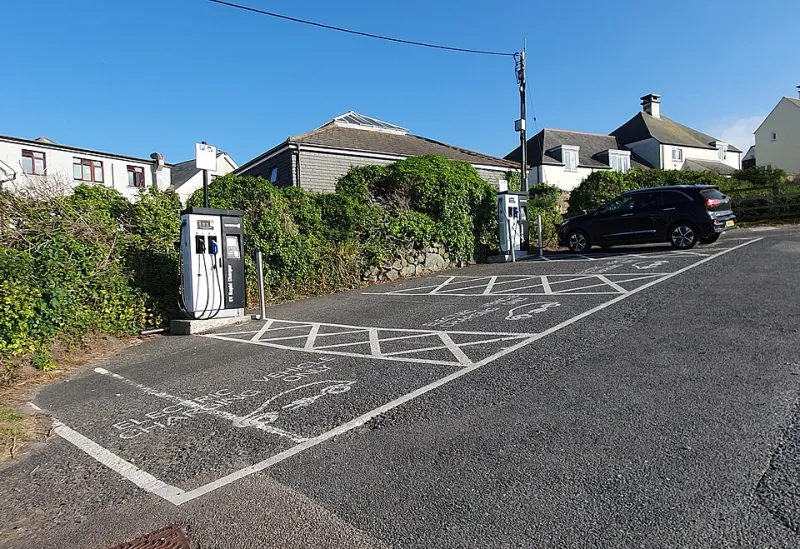
Photo: Mutney, CC BY 4.0, via Wikimedia Commons
There is a particular kind of kerb strike that used to announce itself. A low thud, a scratch of alloy, maybe a yelp from the passenger. In a quiet electric or hybrid car, the same contact can arrive with barely a murmur. You roll away from the bay, nothing seems wrong, and the damage only turns up days later when you wash the wheels or check the pressures.
That is not a reason to avoid EVs. It is a reason to change how you park one. Quiet drivetrains remove some of the noise that used to act as a kerbside alarm. The fix is not better hearing. It is a more deliberate routine.
Why quiet drivetrains change the parking risk
At crawling speed, a petrol or diesel car gives you plenty of background noise: engine idle, fan, maybe a slight vibration through the pedals. An electric car can be almost silent in the cabin, and a hybrid in EV mode is much the same. Road noise from the tyres is low when you are moving at walking pace. The pedestrian warning sound is designed to alert people outside the car, not to guide you into a bay.
That matters because most kerb strikes happen at very low speed. You are not crashing. You are easing the near-side rear wheel towards a kerb that is lower than the door mirror and closer than the camera suggests. The contact can be a soft scuff rather than a bang. The tyre sidewall absorbs some of it, the suspension takes a little more, and the alloy quietly loses a sliver of lacquer or metal.
Electric cars also tend to be heavier, which does not make kerbs softer. A gentle nudge with more weight behind it can do more damage to a sidewall or wheel lip than the noise suggests. The car is not doing anything wrong. It is simply giving you less to work with.
The warning signs are quieter, not gone
A silent kerb strike is rarely completely silent. It is just quieter than the radio. If you train yourself to notice smaller cues, you can catch most of them before they become expensive.
Listen for a change in tyre noise: a sudden rustle of grit, a rubbery squeak, or a short scrape that seems to come from the rear quarter. Feel for a small tug through the steering wheel or a hesitation in the car's movement. Watch for a tiny dip or sideways shuffle from the rear of the car as a wheel meets the kerb. None of these are dramatic. All of them are worth stopping for.
The practical step is to lower the near-side window when you are parking in a tight spot. Turn the radio off and knock the fan down a setting. It feels old-fashioned in a car with cameras and sensors, but your ears still pick up low-speed contact that the cabin insulation hides. In November rain you may not want the window down for long, so do it for the final few metres rather than the whole manoeuvre.
Use the mirrors and cameras on purpose
A dipping door mirror is one of the most useful kerbside tools you have. Set it so you can see the rear wheel and the kerb line together, not just the side of the car. If your car has a 360-degree camera, use it to confirm what the mirrors show, not to replace them. Cameras can distort close-up distances, and a low kerb can sit below the frame or blend into wet tarmac.
Before you move, decide which side the kerb is on and which corner is most at risk. In a parallel park, it is usually the near-side rear wheel. In a bay, it might be the front bumper or the alloy nearest the column. Give that corner your attention for the whole manoeuvre instead of glancing at it once.
If a passenger is helping, agree on simple words before you start: stop, forward, back, plenty. Do not let a conversation turn into a series of guesses. And if you are unsure, stop completely, select park, apply the handbrake and get out to look. That is not a failure of skill. It is cheaper than a refurbished alloy.
A quiet-car parking routine
Try this sequence in tight UK streets, multi-storeys and kerbside bays:
- Before moving, turn off the radio, lower the near-side window and dip the mirror.
- Approach slowly and keep the steering inputs smooth. Do not use the kerb as a brake or a guide.
- Watch the rear wheel and the gap to the kerb, not just the door mirror or the bumper.
- Use the camera for a second opinion, then look out of the window and use the mirror again.
- Stop earlier than you think you need to. You can always creep forward; you cannot un-scuff an alloy.
- If the gap looks wrong, reset. Pull forward, straighten up and start the manoeuvre again.
Reverse parking into a bay often gives you a better view of the kerb than nose-first parking, because the rear camera and mirrors are pointed at the ground. It is not a universal rule, but it is worth choosing the approach that lets you see the wheel you are most likely to damage.
What to check after a suspected silent strike
Park somewhere safe and inspect the near-side corner in good light. Look at the tyre sidewall for scuffs, cuts, bulges or cords. Run your eyes around the alloy lip for fresh grazes, cracks or missing lacquer. Check the wheel arch, the lower bumper edge and the sill for paint transfer or a new scuff. A torch helps, especially on a dark November afternoon.
Then check the tyre pressure with a proper gauge, not just the dashboard display. A kerb strike can knock a valve or damage a bead without setting off the warning light straight away. If you see a bulge, a cut deep enough to show cords, or a wheel that looks cracked, do not drive on it. A sealant kit will not repair sidewall damage, and a space saver has its own limits.
After a few miles, pay attention to vibration through the steering wheel or a car that pulls to one side. That can point to wheel damage or alignment that needs checking. If the strike felt minor but the steering now sits off-centre, get it looked at. Quiet cars are good at hiding damage; they are not good at making it disappear.
The kerb does not need to be loud to be expensive. In a quiet car, the job is to replace the noise you have lost with a routine you can trust: window down, radio off, mirror dipped, eyes on the wheel. Do that and a silent scrape becomes something you notice before it becomes a repair bill.