The Birthday on Your Sidewall: Why a Five-Millimetre Tread Can Still Be a Dead Tyre
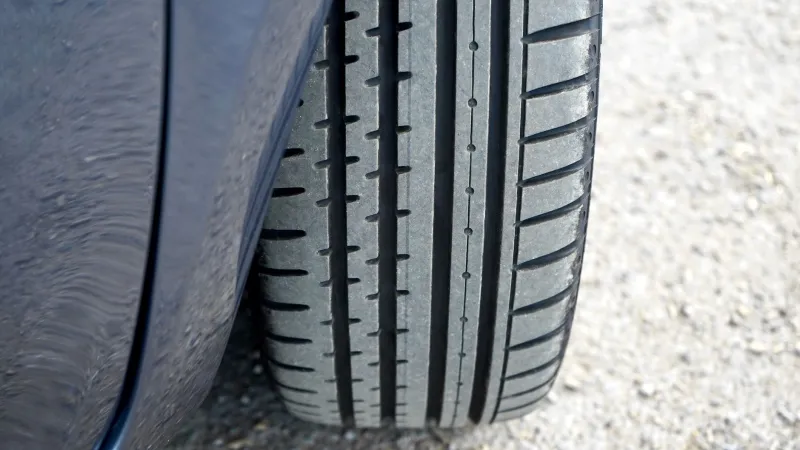
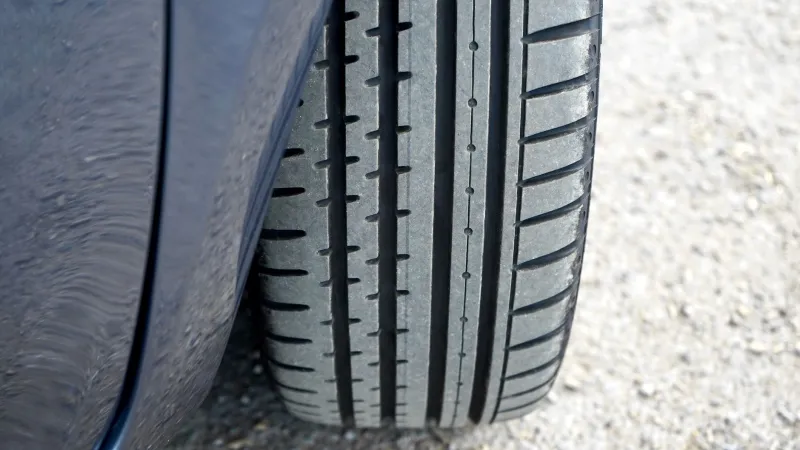
There's a certain comfort in a tread depth gauge. Push it into the groove, see five or six millimetres staring back at you, and the brain files the whole thing under 'fine, leave it'. It's a tidy, satisfying number. And it tells you almost nothing about whether the tyre is actually still doing its job.
Because rubber isn't just a shape. It's a chemical recipe, and that recipe starts to go off the moment the tyre leaves the mould. Oils migrate. Anti-ozonants work their way to the surface and get used up. The compound slowly stiffens, and a stiff tyre gives up grip long before it gives up tread. That's the bit most of us never check — and it's written right there on the sidewall in four digits.
The four-digit code, and where it hides
Every tyre sold in the UK carries a DOT code, and the last four digits of it are the tyre's date of birth. The first two are the week of manufacture, the second two are the year. So 3424 means the 34th week of 2024 — somewhere in late August. 0819 means the eighth week of 2019. No maths required, just read it like a date written backwards.
Finding it is the fiddly bit. It's moulded into the lower sidewall, usually on one side only, inside an oval depression that looks a bit like a raised blister. Because it's only on one face, you may need to shuffle the car forward half a metre to bring it round to where you can see it. On the near side, get someone to hold the steering on full lock towards the kerb and the code will often swing into view behind the wheel arch.
A few things to know before you start cursing the position of it:
- Three digits means very old. Anything made before 2000 uses a three-digit format, where the last digit is the year and you have to guess the decade. If you find one of those on a roadgoing car in 2026, that's your answer.
- Some tyres are stamped on both sides, particularly from certain manufacturers. Worth a look at the inner face if the outer one is blank.
- Part-worns can be genuinely decent — but the code is non-negotiable. A tyre with 7mm of tread and a 2013 stamp is a bad buy, however keen the price.
The ten-year line everyone quotes and nobody checks
There's no legal age limit for car tyres in the UK. Your MOT tester will look at condition, tread depth and sidewall damage, but the date code won't fail a car on its own. What the industry does say — and this is consistent across the major manufacturers and the tyre trade bodies — is that tyres should be inspected closely from around five or six years old, and replaced at ten regardless of tread, unless the manufacturer says otherwise.
Ten years sounds like a long time. It isn't, when you consider that a tyre spends that decade being baked, frozen, UV-blasted and pressed into kerbs by a two-tonne car.
And here's where the low-mileage car catches people out. A second car that does 3,000 miles a year, a weekend classic, a motorhome that sits under a cover from October to April — these are exactly the vehicles sitting on elderly rubber with tread you could measure with a ruler and admire. The compound has had a decade to cure. It will feel wooden in the wet, it will take longer to warm up, and in a hard stop on a damp November roundabout it will surprise you in the worst way.
The kerbside check: five minutes, one torch
You don't need a ramp. You need a torch, a phone, and knees that don't mind a bit of tarmac.
- Read all four date codes. Write them down. If they don't match, someone has been swapping tyres about, and you want to know that.
- Look at the sidewall in raking light. Shine the torch along the flank rather than at it. Cracks hide from direct light. You're looking for fine crazing, like the surface of an old leather sofa.
- Check the shoulder and the bead area. Small splits where the sidewall meets the tread, or hairline cracks around the rim, are a firm no.
- Squeeze the tread blocks. Fresh rubber feels pliable. Old rubber feels like a pencil eraser left in a hot car.
- Look for bulges and flat spots. A bulge in the sidewall is structural damage, not ageing — stop driving and get it looked at.
- Repeat on the spare. The boot well is where tyres go to be forgotten. A space saver from 2011 that's never seen daylight is still a 2011 tyre, and if you're relying on it for a motorway limp home, that matters.
The stored set in the garage
If you run a second set of wheels — winters, track-day rubber, a caravan's worth — the storage method is half the battle. Tyres degrade faster in UV light, in ozone (near electric motors, welders, or anything with a strong chemical smell), and when they're sat flat and compressed under their own weight.
Keep them upright, out of sunlight, away from solvents, and ideally on a rack rather than stacked in a heap. And put a strip of tape on each one with the date code written on it, because you will not remember which year you bought them. Nobody does.
What to do with the bad news
If you've found a tyre past its tenth birthday, don't panic-drive to the nearest fitter at 70mph. Get it replaced at your convenience, keep speeds sensible and leave bigger gaps in the wet until you do. If you've found one at six or seven years old with visible cracking, treat it as urgent.
Tread depth tells you how much rubber is left. The date code tells you whether that rubber is still rubber. Check both, and check them at the kerb rather than at the roadside — a torch and five minutes now beats a conversation with a recovery driver later.