Ramp, Crossover or Crossing? The Dropped Kerb Check That Saves Bumpers and Alloys

Photo: dropped kerb driveway approach car front wheel UK residential street, via www.pabbly.com
A dropped kerb has a helpful look about it. The pavement dips, the gutter softens, and suddenly the car seems invited to glide across. That invitation is often imaginary. Some dropped kerbs are there so people with buggies, wheelchairs and mobility scooters can cross safely. Some are vehicle crossovers for a driveway. Some are service access points. Very few are a free pass to park wherever the ramp happens to be.
Get it wrong and you can collect two different penalties: a parking ticket, or a scuffed alloy and a cracked front lip. The second one tends to hurt more because you have to look at it every morning.
First, work out what kind of dropped kerb you’re looking at
Not all lowered kerbs are built for cars. A pedestrian crossing point often has tactile paving — those bumpy or ribbed slabs — and sits near a junction, crossing or school entrance. Parking there is a poor idea even before the enforcement conversation starts, because you’re blocking the exact bit of pavement that people need to use.
A vehicle crossover is the one that leads to a driveway or garage. It may have a dropped kerb, a sloped apron and sometimes a white line across the footway. It exists so a car can get in and out, not so the rest of us can treat the ramp as a parking space. If someone’s drive is empty, that does not make the crossover fair game. They may be out, or about to come home, or waiting for a delivery that needs the access clear.
Then there are the odd ones: service accesses, farm entrances, builders’ yards, and dropped kerbs that seem to lead nowhere useful. Treat them all with the same suspicion. If the ramp is not yours to use, don’t park across it.
The parking bit: etiquette before enforcement
Rules around dropped kerbs are not identical across the UK. Local councils enforce parking in different ways, London boroughs have their own patchwork of orders, and Scotland has its own pavement parking regime. Some dropped-kerb obstruction is dealt with by civil enforcement officers; some is a police matter; some is simply antisocial behaviour that nonetheless ruins someone’s day.
So don’t rely on the absence of a yellow line to mean “fine”. Check signs, check the road markings, check whether the kerb serves a crossing or a driveway, and use a bit of common sense. If you’re blocking a dropped kerb that someone needs, you’re in the wrong even if a ticket never lands on the windscreen.
If you’re visiting a house and the drive is empty, ask before parking across it. If there’s nobody to ask, leave the crossover clear. It’s a small detour for you and a much better afternoon for whoever comes home with a boot full of shopping.
Approach angle: the bit your bumper actually cares about
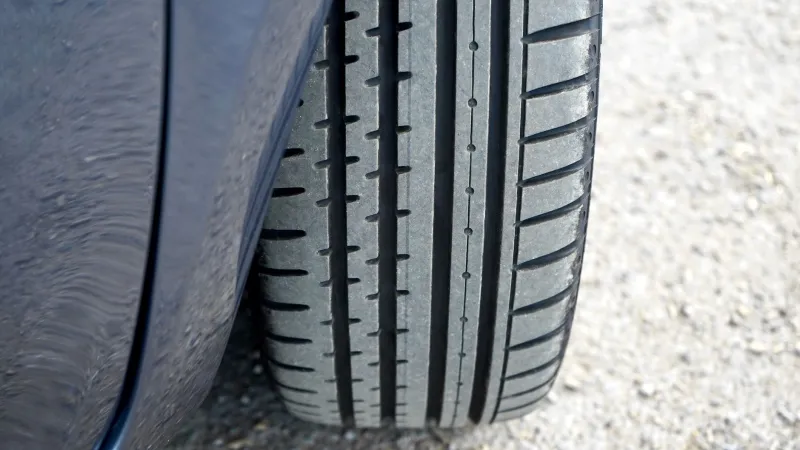
A dropped kerb is not a guarantee of a smooth transition. It can have a raised lip where the ramp meets the road, a gully drain, a steep apron, loose gravel, or a camber that tips the car just as the front wheel commits. Low-profile tyres have less sidewall to flex, wide alloys often sit proud of the tyre, and a deep front bumper can find a kerb edge that the driver never sees from behind the wheel.
There’s no magic angle that works everywhere. A shallow diagonal can soften the jolt through the suspension, but too much angle presents the sidewall and the face of the alloy to the kerb edge. Square-on can thump the front lip and send a jolt through both front wheels at once. The useful rule is to line up with the ramp’s shape, not with the gutter. If the crossover is wide and gently sloped, use the middle and keep the wheels straight as they cross. If it’s narrow, uneven or patched with old tarmac, slow down and let one wheel at a time do the work where it’s safe to do so.
And avoid the classic mistake: turning while the front wheel is still on the ramp. That’s how a sidewall gets pinched between alloy and kerb stone. Get the car straight first, then turn once the wheel is clear.
The three-second recce before you commit the nose
Before the front bumper goes over the lip, stop. It takes seconds and saves money.
Look at the lip height, the drain cover, the paint lines and the tactile paving. Check for loose gravel or a broken kerb edge. Look at your load — a full boot, three passengers and a roof box all change your clearance. Glance at the tyre sidewalls and alloys; if they are already scuffed, this is not the moment to add a matching set. At night, use a phone torch or the car’s reversing lights rather than guessing.
If you cannot see the kerb edge clearly, get out and look. It feels ridiculous for about five seconds. It feels much less ridiculous than a cracked bumper.
After you’ve crossed, keep the crossing clear
If you’re parking in a driveway, don’t leave the rear overhang sticking out over the pavement. Keep the dropped kerb clear for pedestrians and for anyone else who needs the crossing point. If you’re parking on the street, leave enough space that a wheelchair, buggy or mobility scooter can still get past. A dropped kerb is a piece of access infrastructure, not a decorative feature.
If it scrapes, stop being optimistic
A scrape is information. Stop, get out and inspect the tyre sidewall, the alloy rim and the bumper lip. Look for a bulge, a cut, a hiss or a chunk missing from the wheel. If the tyre is damaged, don’t drive on it and hope. If the alloy is cracked or bent, get it checked properly.
Dropped kerbs are useful things. They are just not invitations. Read the ramp, keep the crossing clear and treat the approach like a small piece of driving rather than a gamble — your bumper and your alloy will thank you.