Frosty Start, Glowing Tyre Symbol: What Your TPMS Is Really Saying
Photo: Greg Gjerdingen from Willmar, USA, CC BY 2.0, via Wikimedia Commons
November mornings have a way of making a car feel older than it is. You turn the key, the dash does its usual light show, and then one symbol stays put: the tyre pressure warning. On a frosty start, that little horseshoe with an exclamation mark can feel like a verdict. It is not. It is a prompt to check, and the difference matters.
Cold air is not automatically a crisis
Tyres are not balloons, but they do behave a bit like them when the temperature drops. Air contracts as it cools, so a tyre that was perfectly happy at 15°C can look under pressure by the time the first frost has settled. A rough rule of thumb is that a tyre can lose around 1 psi for every 5 to 6°C of temperature drop. In plain UK terms, a sharp cold snap can easily knock a couple of psi out of every tyre overnight.
That is why the light often appears on all four corners at once on the first properly cold morning. If all four tyres are a little low, and they were fine the week before, physics is doing its thing. It still needs correcting, but it is not the same as finding one tyre half flat outside a chippy.
What the light is actually telling you
Most modern cars use a direct TPMS, with battery-powered sensors in the valves that radio pressure readings to the car. Older or simpler systems can use the ABS wheel-speed sensors to infer a soft tyre from the way it rolls. Both are useful, and both have limits.
A solid warning light usually means the system has noticed pressure outside the expected range. A light that flashes for a while and then stays on often points to a sensor or system fault rather than simple pressure loss. Cars differ, so the handbook is worth a look, but the principle is the same: read the light as a question, not an answer.
The two-minute kerbside check
Pull off the road properly, not half on a bend with the hazards doing their best. Handbrake on, engine off where appropriate, and gloves on if it is genuinely frosty. A torch is useful even in daylight because the inner sidewall is where the nasty surprises hide.
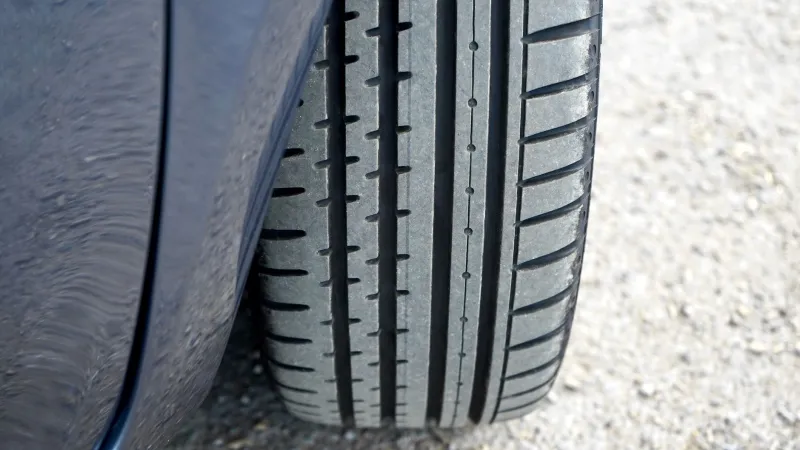
Find the pressure placard, usually inside the driver's door shut, on the fuel flap or in the handbook. Check all four tyres and the spare if you have one. Look at the valve caps, the sidewalls and the tread while you are there. A visual check will not tell you the pressure, but it will show a bulge, a tear, a nail or a shiny kerb rash on the alloy.
Use a proper gauge if you have one. Forecourt air machines are fine, but many now charge, and the gauge on the end of the hose has had a hard life. Inflate to the placard figure, not the maximum pressure moulded into the sidewall. That number is a limit, not a target.
One tyre low, three fine: the slow puncture clue
If three tyres are close to the placard and one is noticeably down, cold weather is probably not the whole story. A nail, a leaking valve, a tired seal or a hairline crack in the rim can all cause a slow puncture. Inflate it, reset the system if your car needs that, and check again after a short drive or the next morning.
A tyre that drops again quickly is telling you something. Do not keep topping it up and hoping. Get it inspected properly. A slow puncture that suddenly becomes a fast one at 70mph on a cold motorway is not a theoretical risk.
When a kerb strike changes the story
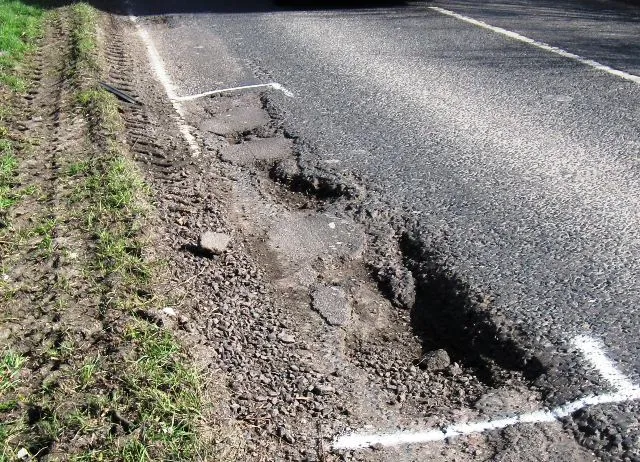
A warning light after a scrape against a kerb deserves more respect than a warning light after a cold night. Kerb impact can damage the inner sidewall, bend a rim, knock a sensor or tear a valve. Turn the steering onto full lock and look at the inside face of the tyre. A bulge, a gouge, exposed cords or a hiss of escaping air means the tyre is done.
Do not drive on a tyre with a sidewall bulge or visible cords. That is not a repair-it-later situation. Put the spare on if you have one and know how, or call recovery. Run-flat tyres have their own rules and their own limits, so check the handbook rather than assuming you can carry on indefinitely.
Reset is not a repair
Many drivers see the light, press the reset button and feel better. But resetting only tells the car that the current pressures are the new normal. If a tyre is low, a reset can mask the problem until the next cold morning or the next motorway slip road.
Inflate first, confirm the pressures, then reset according to the handbook. Some cars need the ignition on but the engine off, some need a menu, some need a short drive. If the light comes back within a day or two, treat that as evidence rather than an annoyance.
When to stop driving and call for help
Stop and get professional help if you find a sidewall bulge, a tear, exposed cords, a visible puncture that is hissing, or a tyre that is visibly flat. Stop if the steering pulls hard to one side or the car feels unstable. Stop if a wheel is hot, if there is smoke, or if the warning light is accompanied by a thump or vibration.
If the tyre is merely a few psi down and holds air after inflation, you can usually drive to a garage or forecourt and monitor it. But do not turn a warning light into a motorway experiment. A five-minute check at the kerb is cheaper than a wheel, a tyre and a recovery truck.
The winter habit that beats the panic
Check your pressures once a week through winter 2026, ideally when the tyres are cold and before you have driven far. Keep a gauge in the glovebox, a pair of gloves in the door pocket and a torch in the boot. It sounds fussy until the first frosty morning when the light stays dark because you already dealt with it.
A TPMS light is not there to ruin your morning. It is there because tyres are the only thing between you and the road, and cold weather makes them work harder. Check, inflate, reset and watch. That is the whole routine, and it beats guessing every time.