The Leftward Drift: Road Camber Versus a Wheel That Has Had a Bang
You are cruising along a familiar A-road, hands light on the wheel, and the car keeps easing left. It is tempting to blame the tracking, a kerbed alloy or a suspension arm that has taken a pothole personally. But before you book a four-wheel alignment, remember that British roads are not flat. They are shaped. And that shape can make a perfectly healthy car drift left.
Start with the road, not the car
Most UK roads are built with a crown, a gentle hump in the middle that helps water run towards the gutters. In the left-hand lane, that means the surface often slopes down towards the near-side verge. A car will naturally follow that slope a little. On a dual carriageway or motorway, the effect can swap: sit in the right-hand lane and the car may seem to wander right instead.
Camber also changes at bends, junctions and where a road has been patched or resurfaced. A slight, steady nudge left that you can correct with a fingertip is often just drainage engineering. It is not proof that a wheel is bent or that the suspension is out of shape.
The flat-car-park test
The useful question is not whether the car pulls left once. It is whether it pulls left on a surface that is not trying to steer it. Find an empty, level car park with permission to use it. Check your tyre pressures first, when the tyres are cold, and set them to the door-plate figures. A soft tyre on one side can mimic a pull and send you chasing the wrong problem.
With the car pointed straight, drive slowly and keep a light grip on the wheel. Do not take your hands off it. Just notice whether the car wants to follow a slope or whether it consistently seeks left even when the tarmac looks flat. Repeat the test in the opposite direction. If the car still drifts left both ways, the road is probably not the culprit. If it follows the slope, camber is doing its normal thing.
You can also compare lanes on a quiet dual carriageway where it is safe to do so. If the drift changes sides with the lane, that points to the road. If it stays left, start looking at the car.
The clues that point to damage
A bent wheel often announces itself with vibration rather than a pull. You might feel a shimmy through the steering wheel at 50-60mph, a thrum through the floor or a wobble that comes and goes with speed. Look at the rim edges for fresh kerb scuffs, flat spots or cracks. A tyre that will not hold pressure after a knock deserves attention too.
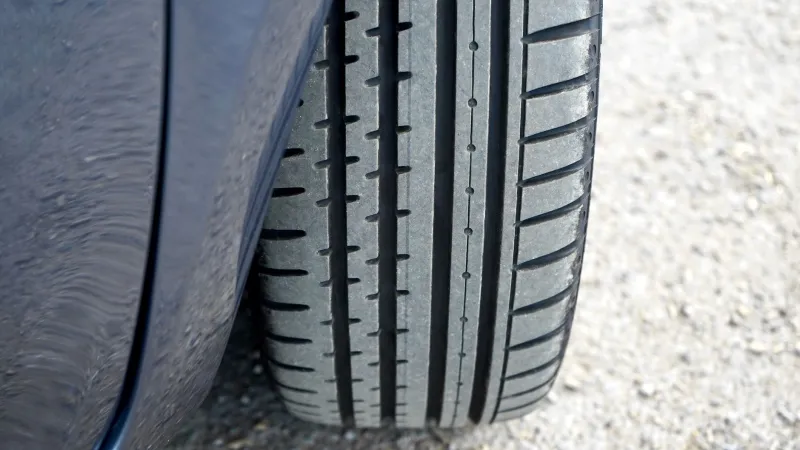
A distorted tyre can be just as sneaky. Check the sidewalls for bulges, cuts or a wavy appearance. Run a hand lightly around the tread and look for uneven wear, a flat spot or a thump that repeats with wheel rotation. A tyre with a sidewall bulge is not a wait-and-see item.
Knocked suspension or steering components can cause a pull, but they usually bring friends: a clunk over bumps, a steering wheel that sits off-centre when you are driving straight, uneven tyre wear, or a car that pulls harder under braking. If the steering feels loose or vague, that is a stop-and-check situation rather than a book-it-next-month situation.
Five minutes at the kerb
Before you drive anywhere, do a quick walkaround. Check pressures cold. Look at both front tyres and both rear tyres, not just the one you remember clouting. Inspect the sidewalls for bulges and the rims for dings. Compare tread depths across the tyre and from side to side. Look for fresh marks on the wheel face or the tyre flank that suggest a recent kerb strike.
Then note how the car behaves. Does it pull only under braking? Does it vibrate at a particular speed? Is the steering wheel crooked? Has a tyre been losing pressure? These details turn a vague complaint into something a technician can actually chase.
When to stop driving
Do not drive on a tyre with a visible sidewall bulge, a cracked or badly bent rim, or a tyre that is rapidly losing pressure. Stop if the car develops a severe vibration, a heavy clunk, or steering that feels loose or unpredictable. A pull that appears suddenly after a pothole or kerb strike is also worth treating seriously. In those cases, get recovery or a mobile tyre fitter rather than nursing it home at speed.
If the car simply drifts left gently and only on crowned roads, you can keep an eye on it and mention it at the next service. But if it pulls left on flat tarmac, wears a tyre unevenly or comes with vibration, book an inspection soon. Ask the garage to check wheel runout, tyre condition and suspension joints before they reach for the alignment gear. Aligning a car with a bent wheel is like straightening a picture on a wonky nail.
The bottom line
Road camber is normal, especially in the left-hand lane on a crowned UK road. A persistent left pull on a flat surface is not. Use a level car park, cold tyre pressures and a bit of patience to separate the two. If damage is suspected, fix the cause first and worry about the alignment afterwards.