A Scuff Is Evidence, Not Decoration: Checking Your Car After a Kerb Strike
Most kerb strikes announce themselves with a noise you feel in your teeth. Then you get out, see a bit of scuffed alloy or a mark on the tyre wall, and decide it is cosmetic. Sometimes it is. Sometimes it is the first clue in a chain of damage that will not show up properly until the car is on a ramp, or until the MOT tester gives the wheel a wobble. The smart move is to treat that scuff as evidence rather than decoration.
This is not about panicking over every brush with a council kerb. It is about doing a sensible, structured check at the roadside while the strike is fresh, then deciding whether you need a proper inspection. A cheap visual check has its limits. Knowing those limits is what separates a five-minute reassurance from a costly wait-and-see.
Start with what you actually hit
A glancing scrape against a low kerb is different from a square-on hit at speed. Ask yourself three things: how fast were you going, what angle did the wheel meet the kerb, and did the steering wheel twitch or pull afterwards? A slow shuffle into a kerb while parking is usually kind to the suspension. A 20mph thump with the wheel turned can load the sidewall and rim in a way that leaves no obvious mark from the driver's seat.
Also note which wheel took the hit. Near-side front is the usual suspect in the UK, especially on tight residential streets and when edging past parked vans. Near-side rear gets forgotten because you cannot see it as easily from the driver's door. If you are unsure, check all four corners rather than just the obvious one.
The two-minute kerbside look
Park somewhere safe, switch off, and give the wheel a proper look rather than a glance. You are checking four things: the tyre sidewall, the wheel rim, the arch liner and the steering feel.
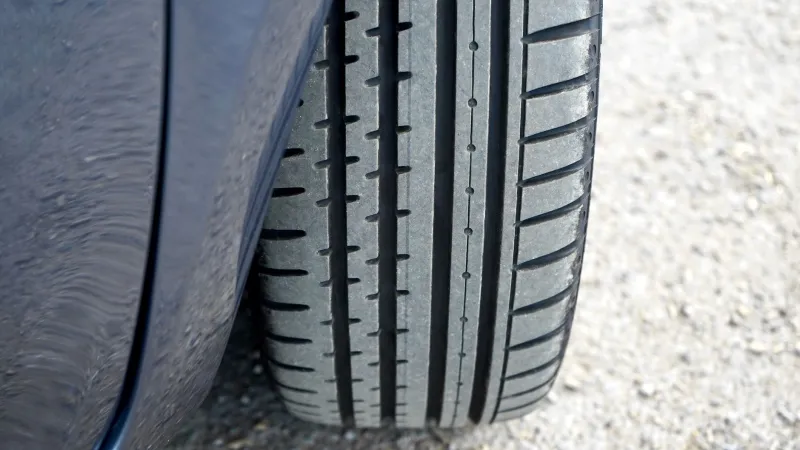
Start with the sidewall. Look for a bulge, a blister or a wrinkle that was not there before. Run your hand around the inner and outer sidewall if you can reach safely. A bubble is not a cosmetic flaw; it is a weak spot in the tyre structure. If you find one, do not plan a motorway trip and do not leave it until the MOT. Get it assessed promptly.
Next, look at the rim. A scuff on the face of an alloy is common. A bend in the lip or a flat spot on the inner edge is more serious. Check the tyre bead area where the rubber meets the rim. If the tyre looks like it has been pushed away from the wheel, or if you can see cords, stop treating it as a kerbside DIY check and get professional help.
Look behind the wheel, too. A hard strike can crack or dislodge plastic arch liners, bend a bracket or leave a trail of grit where it should not be. It is not proof of suspension damage, but it is a reason to look further.
Finally, sit in the car and turn the wheel gently lock to lock with the engine running if it is safe to do so. Listen for a new creak, click or graunch. Then take a short, low-speed drive and note whether the steering wheel is still centred when you are going straight.
When a cheap visual check is not enough
A visual check cannot tell you whether a wheel is buckled by a few millimetres, whether the tracking has drifted, or whether a wheel bearing has started to complain. It also cannot rule out internal tyre damage. That is the point where the scuff stops being a paintwork story and becomes a diagnostics job.
Book an inspection if you notice any of the following: a vibration through the steering wheel or floor at speed, a steering wheel that sits off-centre on a straight road, a pull to one side, a new humming or droning noise that changes with road speed, a tyre that keeps losing pressure, or a sidewall bulge of any size. Those symptoms do not always mean disaster, but they are exactly the sort of clues an MOT tester or technician can chase properly.
It is also worth remembering what an MOT does and does not do. It checks the condition of tyres, wheels, suspension and steering against minimum standards, but it is not a full geometry check and it will not necessarily flag a subtle alignment drift. A car can pass its MOT and still feel wrong. If the scuff came with a thump, get the geometry checked rather than assuming a pass certificate means all is well.
Reading the noise after the strike
Noises are evidence too. A wheel bearing that has been shocked can start as a faint hum that grows with speed. A buckled rim can produce a rhythmic thump or a vibration that comes and goes with tyre rotation. A damaged tyre can thrum or feel vague. None of these are guaranteed after a kerb strike, but they are worth listening for over the next few days.
Do not turn the radio up to drown out a new noise. Drive with the window down at low speed on a quiet street and listen. Then take a short stretch of faster road if it is safe and legal, and note whether the sound changes when you steer gently left or right. That sort of detail is genuinely useful when you speak to a garage.
Keep the evidence, ask the right questions
Take a photo of the scuff, the wheel and the tyre sidewall while the car is clean enough to see the damage. Note the date and roughly what happened. If you later need a repair, an MOT retest or a conversation about pothole or kerb damage, that record is more useful than a vague memory.
When you book the car in, say what happened rather than just asking for a once-over. Ask them to check the wheel for runout, inspect the tyre for sidewall damage, check the alignment and listen for bearing noise. A good technician will appreciate the steer. A scuff is not a diagnosis on its own, but it is a useful starting point. Treat it as evidence, and you are far less likely to miss the expensive bit hiding behind the cosmetic one.