The Gloomy Edge: Parking Near Kerbs After Dark Without Guesswork
Photo: HenryLi, CC BY-SA 4.0, via Wikimedia Commons
Dark by half four, a wet road, and a kerb that seems to have packed up for the night. That is the classic winter parking scenario: you know the edge is there somewhere, but between the rain, the headlight shadows and the grimy passenger window, it has stopped being something you can see and become something you infer. Inference is fine for pub quizzes. It is not fine for alloy wheels.
The good news is that night parking near kerbs does not require superhero vision. It requires a routine that accepts the limits of your eyes, your mirrors and your cameras, then adds a simple check at the end. Think of it as kerbside smarts for the hours when the kerb goes quiet.
Why the edge disappears after dark
In daylight, a kerb reads as a hard line: pale stone against dark tarmac, or a raised edge catching the sun. After dark, that contrast often collapses. Wet asphalt reflects streetlights and headlamps, so the road surface and the kerb can end up in the same grey-brown family. Rain on the passenger mirror turns a crisp edge into a smeared brushstroke. A dirty side window adds a second layer of fog. Add long shadows from parked cars and the whole near side becomes a rumour.
The risk is not usually a dramatic crash. It is the slow, expensive stuff: a tyre sidewall pinched against a kerb, a wheel face scuffed by a stone edge, or a mirror casing clipped because the gap was narrower than it looked. In winter 2026, with darker commutes and wetter streets, that little misjudgement has more opportunity to happen.
Cameras are assistants, not eyewitnesses
Reversing cameras and 360-degree systems are genuinely useful, but they are not honest witnesses in the dark. A camera lens smeared with road film turns bright points into blooms. Low-light grain hides the exact point where tyre meets kerb. Wide-angle lenses make nearby objects look further away than they are, and the on-screen guidelines are fixed graphics, not a measurement of your actual sidewall.
Use the camera as one source of information, not the only one. Keep your eyes moving between the screen, the near-side mirror and the view out of the side window. If the screen is the only thing you are watching, you are driving a video game with a real repair bill attached. Clean the camera lens when you clean the windows, and turn the screen brightness down a notch if it is washing out the real world.
Mirrors, reference points and the near-side habit
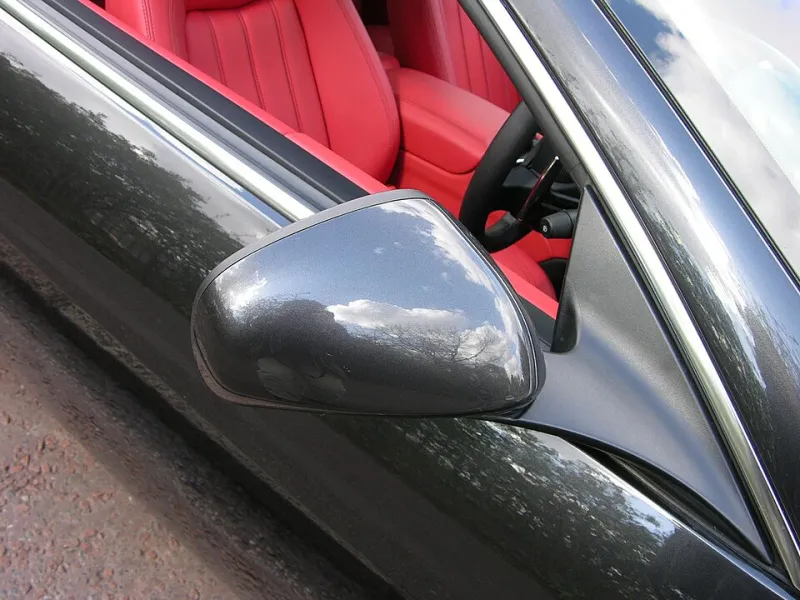
In the UK, the near side is the passenger side, and that is usually the side that finds the kerb. Before you start manoeuvring, dip the passenger mirror if your car allows it. A mirror angled down towards the rear wheel shows the gap between tyre and kerb far better than a mirror set for traffic. Wipe the mirror glass with a cloth if it is beaded with rain; it takes two seconds and saves a lot of squinting.
Reference points help, but they must be learned in daylight. Find a quiet, dry car park and notice where the kerb sits in relation to your passenger mirror, your door handle or the edge of the bonnet when the car is straight and safely spaced. Do not copy another driver's reference points, because seat height, mirror position and car shape all change the view. Once you know your own car's visual landmarks, they become much more reliable after dark.
Street furniture can act as a guide too. Drain covers, white lines, lamp posts and the wheels of parked cars give you fixed points. If the kerb itself is hard to see, look for the things that sit beside it. Just remember that a wet drain cover can look like a puddle, and a puddle can look like a pothole. When in doubt, slow down and use a torch rather than committing to a guess.
Reflections are clues, not guarantees
Wet surfaces are surprisingly good at showing edges. A puddle along the gutter often catches streetlight or headlamp glare and reveals the line of the kerb. Shop windows, glossy wheelie bins and even the side of a parked van can throw back enough light to show the gap. Reflections are useful clues, but they are not guarantees: a puddle can spread beyond the kerb, and a reflection can make a shallow edge look deeper.
Use reflections to build a picture, then confirm with a mirror or a physical check. If you are parking on a residential street and the near-side mirror is showing nothing but black, stop. Reversing a little and adjusting your angle is cheaper than a refurbished alloy. A second shunt is not a failure; it is a correction.
The two-minute post-park audit
Once you have stopped, do not just switch off and walk away. Put the handbrake on, leave the car in gear or park, and take a quick walk around the near side with a torch or your phone light. This is the step most drivers skip, and it is the one that catches the problem while it is still cheap.
Look at the tyre sidewall for a fresh pinch mark, a bulge or a slice. Check the alloy face for scuffs and the tyre bead for any sign that it has been pushed off the rim. Look along the side of the car to see whether the gap to the kerb is sensible, and check that the mirror is not folded against a wall or a bin. If something looks wrong, move the car rather than leaving it until morning. A sidewall injury can worsen overnight, and a wheel that is touching a kerb can be damaged further by the next driver squeezing past.
A small kit and a calmer routine
You do not need much: a small torch kept in the door pocket, a microfibre cloth for mirrors and camera lenses, and the discipline to clean the side windows properly when you fill up. Keep the washer bottle topped up with the right winter mix and treat the glass if it smears. Clear side glass is not a luxury in December; it is part of the braking system for your judgement.
After dark, the kerb does not have to be invisible. It just has to be treated with respect. Slow the manoeuvre down, use the mirror and the camera as a pair, look for reflections and fixed reference points, then get out and check. Kerbisher's rule for winter nights is simple: if you cannot see the edge clearly, do not let the car decide where it is.