Five Minutes With a Gauge Beats a Pocket Full of Coins

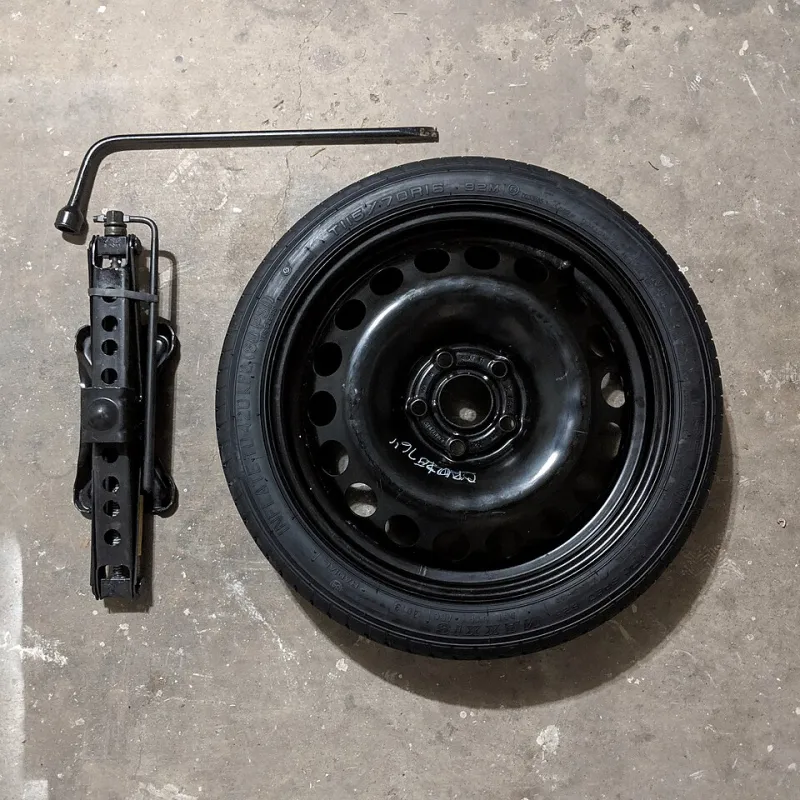
Photo: Betty Longbottom , CC BY-SA 2.0, via Wikimedia Commons
There is a certain comfort in the 20p tread test. It costs nothing, it lives in the glovebox, and it gives you an answer in about four seconds. Slot the coin into the tread, see whether the outer band disappears, and carry on with your day. The trouble is that a coin can make a tyre look healthier than it really is — and on a wet November morning in Britain, that is not the sort of optimism you want underneath you.
The coin is a rough guide, not a referee
The idea behind the 20p trick is simple enough. The distance between the coin's rim and the edge of its raised band is often said to be around 1.6mm, which happens to be the UK legal minimum for car tyre tread. If the band is still visible when the coin sits in the groove, the thinking goes, the tyre must be past the limit. If it disappears, you are fine.
That is a useful bit of driveway folklore, but it has two problems. First, coins wear, grooves vary, and the way you angle the coin changes what you see. Second, and far more importantly, the test only tells you about the small patch of tread you happen to poke. It says nothing about the inner edge, the full width of the tread face, or the rest of the tyre's circumference. A tyre is not a single groove. It is a working surface, and it can be worn unevenly.
Where the coin test goes quiet
The classic blind spot is the inner shoulder. Modern cars often run negative camber or slightly toe-out geometry, and that can scrub the inside edge harder than the outside. You can have a tyre that passes the coin test on the outer ribs while the inner edge is down to the cords. From the kerbside, with the car parked and the wheel turned slightly, that inner edge can be almost invisible unless you deliberately look for it.
Then there is irregular wear. A tyre can be legally borderline in one place and comfortably above the limit in another. If the centre is fine but both shoulders are scrubbed, a single coin reading down the middle is meaningless. The same goes for flat-spotted tyres, tyres with a lumpy or sawtooth wear pattern, and tyres that have been run under-inflated for months. None of those problems announce themselves through a coin slot.
And while we are being honest about tyres: tread depth is only one part of the MOT picture. Cuts, bulges, exposed cords, perished sidewalls and pressure problems all matter. A tyre can have 4mm of tread and still be unfit for the road. The coin cannot see any of that.
The five-minute check that actually tells you something
You do not need a workshop to get a better picture. You need a proper tread depth gauge, a torch, and five minutes without a queue of traffic behind you.
Start with the tyres cold and the car parked safely, ideally with the handbrake on and the wheels straight or turned enough to expose the inner edge. A small torch is genuinely useful here — phone lights are fine, but a slim torch gets into the grooves and lights up the sidewall better.
Take readings across the full tread face, not just the middle. Aim for the outer shoulder, the centre ribs and the inner shoulder. Do this at several points around the circumference — say, three or four positions per tyre. Write the lowest number down. The lowest reading is the one that matters, not the average and certainly not the best-looking groove.
While you are down there, look along the sidewall for cracks, bulges, cuts and embedded objects. Check that the valve cap is present and the valve itself is not perished. Run a hand lightly around the tread — not into a hot tyre immediately after a fast run — and feel for sharp edges or uneven blocks. If you spot a nail, do not pull it out at the kerb. Get it assessed properly.
What the law actually asks for
For cars and light vans in the UK, the legal minimum tread depth is 1.6mm across the central three-quarters of the tyre's breadth and around the entire circumference. That is the headline figure, but it is not a target. Grip in the wet falls away well before you reach the legal line, and a tyre at 1.8mm is not a tyre you want to rely on for a motorway commute in standing water.
This is where the coin test really falls down. It encourages a pass-or-fail mentality at the exact point where you should be thinking about margin. If your lowest reading is close to 1.6mm, stop treating it as a puzzle to be solved at the kerb. Get the tyre checked by a professional and be prepared to replace it. The same applies if you find uneven wear, a bulge, or cords showing through anywhere on the tyre.
When to stop guessing
A tread gauge costs less than a takeaway and lives happily in the glovebox alongside the torch. Use it monthly, before long trips, and whenever the weather turns. Check pressures too, because wrong pressure is a leading cause of irregular wear — and irregular wear is exactly what the coin test is worst at spotting.
If you are not sure what you are looking at, that is not a failure. Tyres are safety equipment, and a second opinion from a tyre bay is cheaper than a claim, a recovery truck or a very long walk home. The 20p test is fine as a memory jog. It is not a diagnosis. Five minutes with a gauge, a torch and a proper look across the whole tread face will tell you far more — and it will not let a worn inner edge quietly pass you by.