The Edge Is Not Standard: Reading Britain's Mismatched Kerbs Before You Park
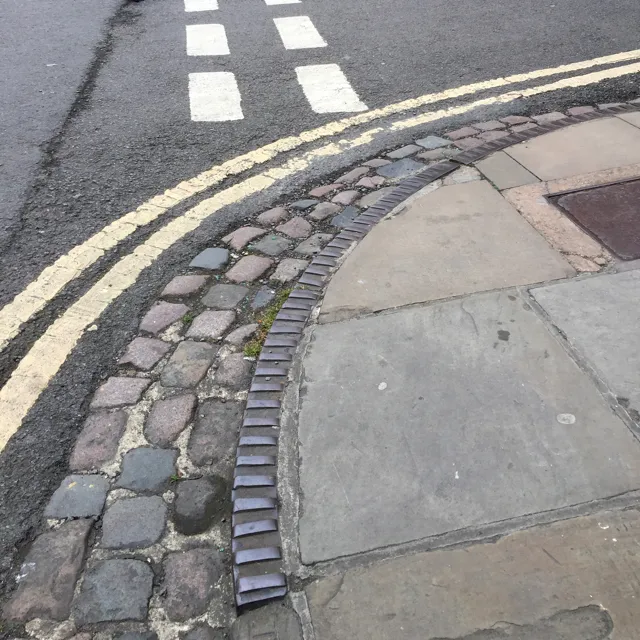
Photo: Robin Stott , CC BY-SA 2.0, via Wikimedia Commons
You park on a familiar street every morning. The kerb there is a low, rounded lip — barely a speed bump for your tyre. Then you visit a friend two postcodes away, swing into a bay with the same confident arc, and hear the sound every driver dreads: a sharp, gritty scrape that travels up through the steering wheel and straight into your wallet.
Nothing about your driving changed. The kerb did.
Why Britain's Kerbs Are a Patchwork
There is no national kerb standard that survives contact with reality. A Victorian granite edge in an old market town can sit 150mm proud of the gutter, worn smooth by a century of lorry tyres but still hard enough to take a chunk out of a modern alloy. A new-build estate might use block paving and a shallow concrete lip that looks harmless until you notice the sharp chamfer. Then there are the build-outs around bus stops, the raised tables at crossings, the conservation-area stones that lean like tired teeth, and the temporary kerbs around roadworks that seem designed to catch anyone who trusts their parking sensors.
Councils maintain what they inherited, patch what they can afford, and replace like with like when the budget allows. The result is a kerbside landscape that changes character every few streets. The height, the shape and the hardness of the edge are all variables. Your car's clearance is a fixed number. That mismatch is the lottery.
Reading the Edge: What to Look For
Before you commit to a bay, get out and look. Not a quick glance from the driver's seat — a proper two-second inspection of the kerb face. Start with height. A useful rule of thumb: if the kerb face is taller than the sidewall of your tyre, you are already in the danger zone. Low-profile tyres often have less than 100mm of rubber between the rim and the road, so a standard 125mm kerb can reach the alloy before the tyre has a chance to cushion anything.
Next, look at the profile. A rounded, worn kerb is more forgiving than a fresh, square-edged one. A chamfered edge — where the top slopes away — gives you a little ramp effect. A vertical face with a sharp lip is the one that bites. Also check the gutter: if there is a deep channel between the road and the kerb, your tyre has to bridge a gap before it even touches the edge, which changes the geometry of the approach.
Look for damage, too. Cracked or missing kerb stones often leave jagged edges and loose chunks. If the kerb has been repaired with mortar or tarmac, treat it as unpredictable. And never assume a dropped kerb is actually dropped to a useful height. Some are little more than a painted slope with a lip at the bottom.
The Angle Matters More Than the Gap
Even a tall kerb can be tackled safely if you approach it at the right angle. Head-on, your tyre takes the full height in one hit. At a shallow angle, the tyre climbs the edge gradually, using its own rounded shoulder to ease the transition. The trick is to avoid the middle ground: too straight and you thump, too shallow and you risk scrubbing the sidewall along the kerb face.
For parking, reverse in where you can. Your steering wheels are at the front, so reversing lets you place the rear tyre precisely and keeps the front overhang away from the edge. If you must go nose-first, stop before the tyre touches, get out and check the gap. Parking sensors are useful for walls and cars, but they often miss a low kerb entirely — especially the near-side one.
Low Profiles, Long Noses and Other Losers
Some cars are simply worse at this than others. Long front overhangs — think large estates and saloons — mean the bumper reaches the kerb before the tyre does. Low-profile tyres put the alloy closer to the action. Wide tyres can bulge over the kerb edge and hide the rim until it is too late. And cars with stiff suspension transmit every scrape straight to the cabin, which is at least honest.
If your car has any of these traits, adjust your habits. Choose bays with lower kerbs. Use the door mirror to watch the rear wheel. Take the extra thirty seconds to reverse into a space. The goal is not to become a parking perfectionist; it is to stop donating alloy to concrete.
A Simple Kerbside Test
Here is a check you can do in any unfamiliar street. Park legally, put the handbrake on, and walk back to the kerb. Crouch down and look along the edge at tyre height. You are checking three things: the height of the face, the sharpness of the top edge, and whether the kerb runs straight or wanders. A straight kerb is easier to judge. A wandering one will catch you out as you turn.
Then look at your car's tyre. Find the point where the sidewall meets the rim. If that point is lower than the kerb face, you need a different angle or a different bay. It really is that simple.
When in Doubt, Don't
The kerb-height lottery has no winners, only drivers who have not scraped yet. If a bay looks tight, the kerb looks tall, and your car sits low, find another space. A five-minute walk is cheaper than a refurbished alloy. Britain's streets were not built to a single template, and they are not about to become one. The best you can do is read the edge before it reads your car.